
Every evening, the work begins again.
Logistics yards remain active. Vehicles enter and leave. Equipment sits across large properties. Perimeters need attention, and activity between buildings or beyond a fixed camera’s view still needs to be understood.
For an autonomous robotics company, overnight security presents a concrete assignment: move through a real environment, observe what is happening, provide a visible presence and help people respond when something requires attention.
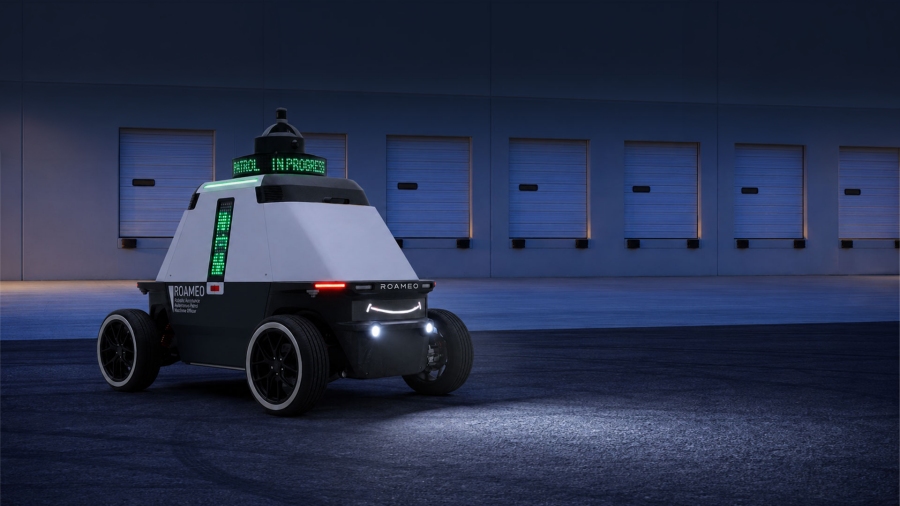
That assignment is central to PURSUON, the company developing and manufacturing ROAMEO, an autonomous security patrol vehicle built to bring Physical AI into outdoor security operations.
Several ROAMEO units are now on the road to their customer destinations. One logistics client has taken multiple units. With those deployments still ahead, PURSUON is entering a consequential stage: bringing its engineering into the environments where customers intend to put it to work.
The night shift helps explain why that matters.
Security patrol involves recurring work with a defined purpose. Follow a route. Observe activity. Check areas that deserve attention. Establish a visible presence. Escalate an exception.
Those responsibilities give autonomous technology a practical place to contribute. They also create demanding conditions. Outdoor environments change. Vehicles move. Lighting varies. People behave unpredictably. A route that looks straightforward on a site map can become more complicated when the property is busy.
Building a machine for that setting requires a close connection between software, hardware and the job itself.
ROAMEO brings mobility, sensing and communication together in a single platform. Its autonomous patrol capability is designed to carry observation through a property. Its audio and visual features support communication and deterrence. Its physical presence makes the patrol visible.
The value of that combination starts with a simple distinction: a mobile platform can bring its capabilities to different locations along an assigned route.
Fixed cameras remain essential. Human officers remain essential for responsibilities involving judgment, authority and physical intervention. Autonomous patrol adds another way to organize coverage, particularly where routine movement across a large property consumes time and attention.
That makes the question broader than whether AI can replace an overnight guard.
The more useful question is how security work can be organized when a machine can take on defined patrol responsibilities and people can focus on the situations that need them.
For PURSUON, answering that question involves much more than building a vehicle that moves.
A customer destination introduces an entire operating environment. Routes need to reflect the property. Connectivity needs to support the intended workflow. Escalation procedures need to be understood. Maintenance and service need to fit the realities of equipment working outdoors.
Manufacturing adds another set of responsibilities. Each additional unit places greater emphasis on consistency, documentation, serviceability and the ability to reproduce what engineering has developed.
These are the disciplines that connect an autonomous platform to a functioning business. They deserve as much attention as the technology visitors can see in a demonstration.
PURSUON’s role is to develop and manufacture ROAMEO. RAD serves as its exclusive distribution channel, connecting the platform with security customers and their operational requirements. That relationship gives the technology a defined route to market and keeps the customer’s intended use close to the conversation.
The logistics client taking multiple ROAMEOs adds a concrete detail to that progress. It puts coordination across multiple units into the next phase of work, alongside the requirements of each individual destination.
As units arrive and deployments begin, the next evidence will come from commissioning, field performance, service experience and customer use. Those stages will help establish how the platform fits into daily operations and where further refinement is needed.
That feedback can inform route planning, hardware decisions, maintenance procedures and future manufacturing. Its usefulness depends on how carefully it is captured and translated into improvements.
This is where Physical AI becomes a company-building discipline.
The intelligence has to work through a physical machine. The machine has to perform an assigned task. The organization behind it has to manufacture, support and improve what it delivers.
PURSUON is building around that connected set of responsibilities, with ROAMEO as its first visible expression.
Overnight security gives the work a clear purpose and a recurring schedule. The properties are real. The responsibilities return every night. And the next chapter begins as ROAMEO reaches the places it is being sent to serve.